From Figure 2 we can also see a disadvantage when using a single channel to drive multiple lamps. Since the feedback signal amplitude of lamp B is higher than that of other lamps, the duty ratio of the power MOSFET shared by multiple lamps will be controlled by it, so that lamp B controls the power supplied to other lamps. As shown in Figure 2, this makes the current drawn by the other lamps smaller than its target value of 5mARMS. Figure 3 shows the situation when the lamp current detection signal is converted to the LCM input of the DS3984 and DS3988. Unlike the scheme for driving a single lamp per channel, AC coupling capacitors are not used for the LCM input in a multi-lamp application per channel. The DS3984 / DS3988 controller controls the lamp current based on the peak signal measured at the LCM input. Without AC coupling capacitors, the peak control level is the DC common voltage (1.35V) plus the lamp regulation threshold (1.0V), or 2.35V (average). Therefore, the peak value of the current detection signal generated by the detection resistor must be attenuated to the target value of 2.35VPEAK and then sent to the LCM, so that the device can control the lamp current at an appropriate level. Example: In Figure 1, 1000 When the signal passes through the small signal diode, the amplitude will be attenuated by about 500mV. The rest is attenuated by a resistor divider. In the example shown in Figure 1, the resistor divider consists of 8.2k Figure 4 shows the overvoltage feedback signal input to the OVD terminal of the DS3984 or DS3988. When the signal passes through the small signal diode, the amplitude is reduced by about 500mV. A resistor divider is used to further attenuate it. In the circuit of Figure 1, the resistor divider consists of 33k In order to ensure that all lamps are properly lit and detect whether any lamps are extinguished during normal operation, some additional circuits must be used to pull down the LCM input when there are any unlit lamps. Four comparators LM339 can be used to achieve this purpose. Each comparator corresponds to a lamp. If all four lamps are lit, the forward voltage swing on the lamp current detection resistor will turn the peak detector (by the diode, 470pF capacitor and 330k Figure 5 shows the peak detection signal that appears at the input of the comparator. Figures 6, 7, and 8 show the normal and abnormal start-up conditions and the conditions when a lamp is open. The advantage of entertainment tablet lies in having a powerful chip and excellent hardware. If you want to play various online videos on the tablet and run various software smoothly, the performance of the hardware is an absolute prerequisite. In addition, a high-speed and stable WIFI module is also required, which must be compatible with multiple 802.11 B/G/N protocols at the same time, so that the webpage can be loaded instantly when the webpage is opened, and the online video can be played smoothly. So hardware is the premise and foundation, without good performance everything else is empty talk. Entertainment Tablet,High capacity battery Tablet,WIFI Tablet Jingjiang Gisen Technology Co.,Ltd , https://www.gisentech.com
The multi-lamp driving scheme only needs to add some supporting circuits, and each channel in the DS3984 and DS3988 can drive more than one CCFL. Figure 1 shows the application circuit for driving four lamps per channel. With only a slight adjustment, you can also drive two, three, four, or more lights per channel. 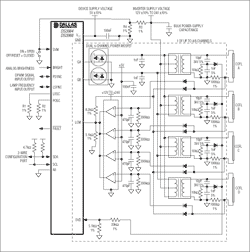
Click for larger image Figure 1. Application example of driving four lamps per channel ). In the application circuit of Figure 1, when the lamp current is 5.0mARMS, the amplitude of the current detection signal generated on the detection resistor is 5.0VRMS (7.07VPEAK). Figure 2 shows lamp A and lamp B at 1000
The current detection signal waveform generated on the detection resistor.
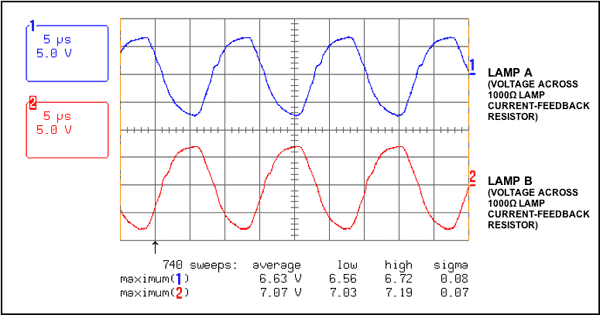
Figure 2. Voltage across the lamp current detection resistor (only two lamps are shown) The 7.07VPEAK signal is generated on the detection resistor, and it must be attenuated to 2.35VPEAK before reaching the LCM input.
And 5.1k
Resistance composition. The 50k input impedance inside the LCM pin will cause slight attenuation. Internal 50k
Impedance makes 5.1k
The voltage divider resistance drops to 4630
; Increase the attenuation.
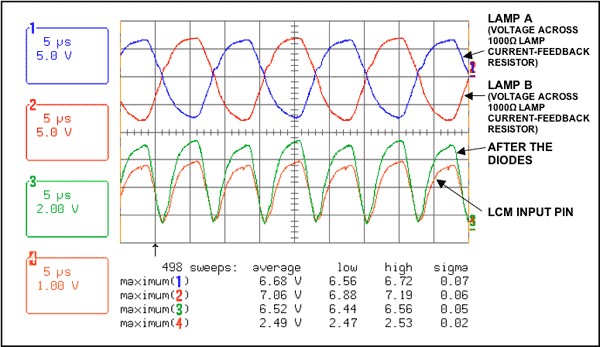
Figure 3. Lamp current feedback signal path ) To provide a DC reference level. According to the resistance of the resistor and the impedance of the low-side capacitor at the operating frequency of the inverter, the actual voltage division ratio will vary. In Figure 1, the circuit operates at a frequency of 68kHz, which means that the impedance of a 1nF capacitor is about 2.3k
. 10k in parallel
After the resistance, the impedance drops to 1896
, So that the effective partial pressure ratio changes from 1: 101 to 1: 124. As shown in Figure 4, the voltage after the capacitor is divided is about 7.2VRMS, which means the lamp operating voltage is about 893VRMS. Note: The waveform in Figure 4 has a small amount of negative DC offset. Change 10k
The resistance of the parallel resistor can change the DC offset. The greater the parallel resistance, the greater the DC offset; the smaller the parallel resistance, the smaller the DC offset. Of course, changing the parallel resistance also affects the voltage division ratio.
And 5.1k
Resistance composition. OVD pin 50k
The input impedance of will increase the attenuation slightly. This 50k
The input impedance makes 5.1k
The voltage divider resistance drops to 4630
, Thus increasing the amount of attenuation.
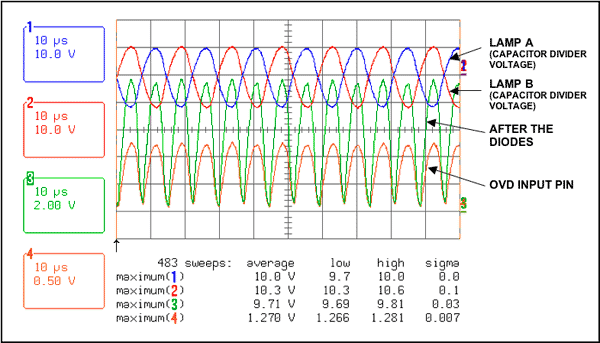
Figure 4. The output voltage of the capacitive voltage divider and the OVD signal path Resistor composition) Charge to a reference voltage higher than 5V. At the same time, the open collector outputs of the four comparators (they are wired or connected) are turned off, allowing the lamp current signal to enter the LCM pin. If one or more lamps are not lit, the corresponding comparator pulls the LCM pin low, telling the DS3984 / DS3988 that there are still unlit lamps.
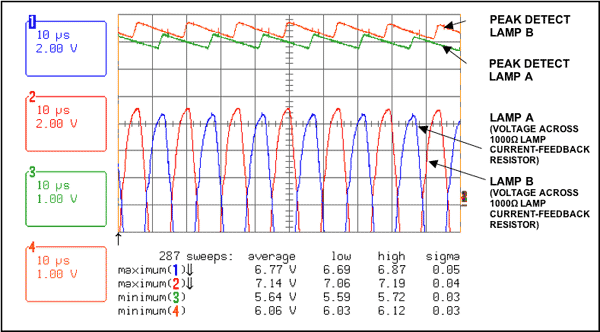
Figure 5. Peak detection signal 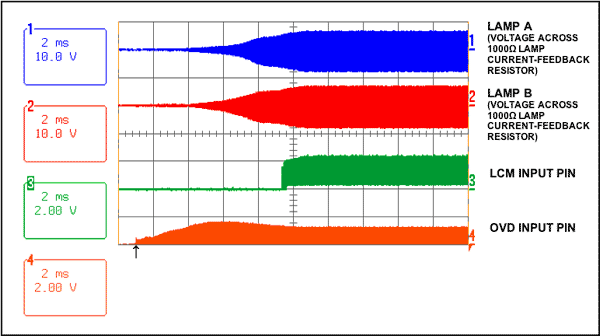
Figure 6. Normal start 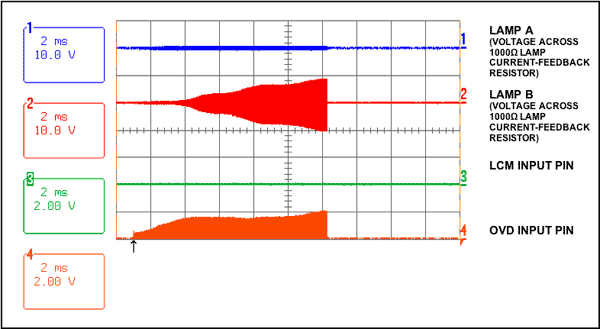
Figure 7. Start-up situation when lamp A is off 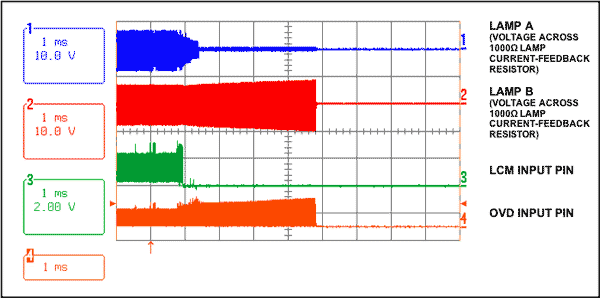
Figure 8. The situation when lamp A is off during normal operation
In addition to having a good CPU as a prerequisite, it is equally important to carry a professional video player. A professional video player must perform equally well both online and offline.
DS3984 / DS3988 multi-lamp driving scheme
Abstract: DS3984 and DS3988 are multi-channel cold cathode fluorescent lamp (CCFL) controllers. DS3984 supports up to four channels, DS3988 supports eight channels. These controllers use a push-pull drive architecture to convert the DC power supply voltage into the high-voltage AC waveform required to drive the CCFL. This application note describes how to drive more than one CCFL per channel.